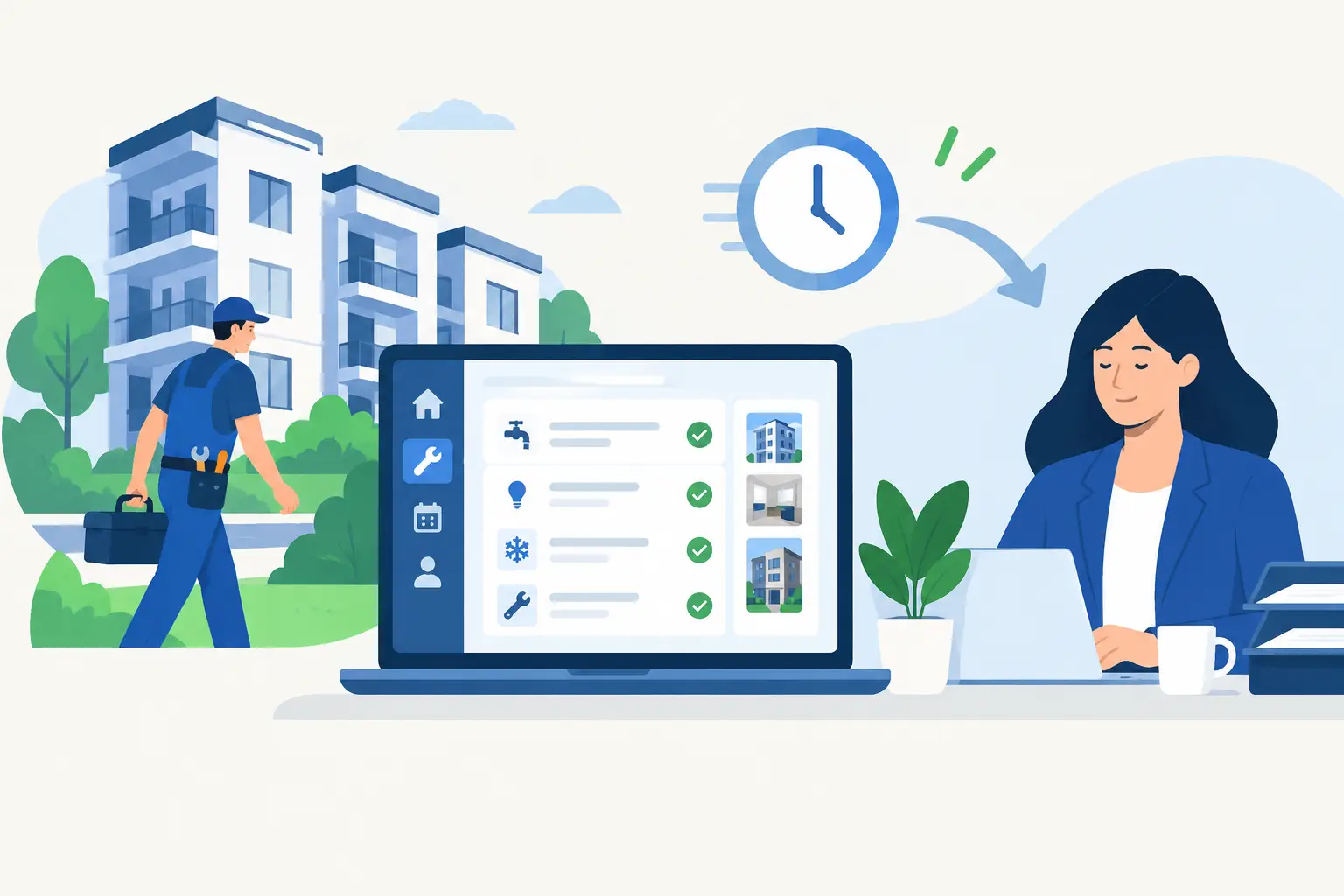
A leaking tap is rarely just a leaking tap. For a letting agent or block manager, it can mean an incoming call, a tenant update, contractor outreach, approval chasing, appointment coordination, invoice queries and a landlord asking for progress. Multiply that by a growing portfolio and maintenance software becomes less about recording repairs and more about protecting operational capacity.
The right system gives teams a clearer route from first report to completed work. It reduces repetitive follow-ups, keeps communication in context and makes it easier to see where a job has stalled before it turns into a complaint.
Why property maintenance creates so much admin
Maintenance is one of the most communication-heavy parts of property management. The initial issue may take two minutes to report, but the work around it can continue for days or weeks. A team may be switching between a CRM, inboxes, WhatsApp messages, spreadsheets, contractor portals and finance software just to establish who said what and what needs to happen next.
That fragmentation has a commercial cost. Administrators spend time searching for updates rather than moving jobs forward. Property managers have limited visibility over outstanding actions. Landlords receive updates only when someone has time to compile them. Tenants, meanwhile, judge service by the speed and clarity of communication, not by how many systems sit behind the scenes.
The challenge is not simply handling more maintenance requests. It is handling them consistently when volumes rise, staff are busy and multiple people need to take action.
What maintenance software should do for your operation
Effective maintenance software should create a reliable workflow around each issue. A repair needs a clear owner, a visible status, a complete communication record and an agreed next step. Without those basics, teams end up relying on memory, personal inboxes and manual chasing.
For lettings, the system should support the journey from tenant report through triage, landlord instruction, contractor attendance and resolution. For block management, it must also handle the extra complexity of communal areas, managing agents, leaseholders, site teams, suppliers and longer-running works.
The best platforms do not force an agency to abandon its CRM or finance package. Instead, they sit alongside core systems as an operational layer, connecting the work that often falls between them. That matters because replacing a whole technology stack is expensive, disruptive and rarely necessary to improve day-to-day control.
A useful system will typically provide automated task creation, shared communication records, reminders for overdue actions, reporting on open works and clear updates for landlords. The value is not the individual feature. It is the reduction in handovers, duplicated effort and uncertainty.
The workflows worth automating first
Not every maintenance process should be automated in the same way. Urgent issues need rapid escalation and human judgement. Routine jobs, status updates and internal reminders are where automation produces the most immediate return.
Capture and triage requests consistently
Start with how issues enter the business. If tenants report maintenance through calls, emails and messages, staff must first translate those reports into structured jobs. That is an avoidable bottleneck.
A better process captures the property, issue type, supporting photos, access information and urgency at the point of reporting. The system can then create the appropriate task and route it to the right person. AI call handling can also help ensure that a report received by phone is logged properly, rather than left in a call note waiting to be processed.
Triage still needs sensible rules. A suspected gas leak, loss of heating during cold weather or water ingress should never be treated like a minor repair. Maintenance software can support escalation paths, but teams must define the policy and make sure staff know when to intervene.
Stop chasing updates manually
The quietest jobs often create the most work. A contractor has not confirmed an appointment, a quote is awaiting approval or a tenant has not responded to an access request. Each gap generates a call, an email and another reminder to check again tomorrow.
Automated follow-ups create consistency without asking administrators to remember every open thread. A task can be triggered when a contractor has not responded within an agreed period, when an approval is outstanding or when a job has been open beyond its target timeframe.
This does not mean automating every message indiscriminately. Too many reminders can frustrate contractors and tenants alike. Use escalation rules for meaningful delays and make messages specific to the action required.
Keep landlord updates visible
Landlords want confidence that issues are being handled, especially when a repair affects tenant retention, compliance or cost. They do not necessarily need a phone call for every movement, but they do need clear access to the information that matters.
A real-time landlord dashboard can show open maintenance issues, current status, costs and recent communication without adding another reporting task to the property manager's week. This reduces routine update requests while giving landlords a better view of how their properties are being managed.
Transparency also improves accountability internally. When updates are visible, it is easier to identify a job awaiting instruction, a recurring contractor delay or a property that is generating disproportionate maintenance spend.
Choosing maintenance software without adding complexity
A feature list is not a buying strategy. Property businesses should assess software against the operational problems that are costing them time and creating service risk.
First, map a handful of real maintenance journeys from the previous month. Include a straightforward repair, an emergency, a job requiring landlord approval and a job that went wrong or took too long. Identify every handover, manual reminder, duplicate entry and point where the team lost visibility. Those are the gaps the platform needs to close.
Then consider integration. If property records, tenancy details and financial data already live in established systems, maintenance software should work with that environment. Re-entering property details or copying updates between platforms simply shifts admin from one place to another.
User adoption matters just as much. A system that looks impressive in a demonstration but requires staff to take five extra steps will not deliver the intended savings. Look for workflows that are straightforward for property managers, administrators and landlords to understand. The platform should reduce decisions for routine work, not create new ones.
Finally, ask how performance will be measured. Open job volumes, average time to first response, overdue approvals, repeat issues and time spent on manual updates are practical indicators. A baseline before implementation gives the business a credible way to assess whether the new workflow is actually reducing admin.
Where teams still need human judgement
Maintenance software improves control, but it cannot decide whether a repair is reasonable, negotiate a difficult situation or manage a distressed tenant. The most effective operations use automation to remove the repetitive work around those decisions.
For example, an automated workflow can collect details, notify the appropriate person and prompt an overdue contractor. A property professional still needs to assess liability, approve exceptional spend, manage sensitive communication and decide when an issue requires a different supplier or faster intervention.
That distinction is useful when setting expectations. The aim is not to make maintenance impersonal. It is to give staff more time for the conversations and decisions that protect relationships, revenue and compliance.
A stronger operating model for growing portfolios
As portfolios grow, informal processes become expensive. A team can manage a limited number of jobs through inboxes and personal knowledge, but that approach breaks down when staff are absent, instructions change or landlords expect immediate answers.
Maintenance software creates a more durable operating model: one where tasks are recorded, responsibilities are clear and communications are shared rather than held by individuals. For agencies and block managers under pressure to do more with lean teams, that control can be more valuable than simply processing jobs faster.
Prop Report is designed around this operational reality, combining automation, shared communication and landlord visibility while working alongside existing CRM and finance systems. The result should be less time spent chasing information and more time spent managing properties well.
The practical next step is to examine the maintenance work your team completed this week. Count the calls, emails and follow-ups that existed only because nobody had a clear, shared view of the job. That is where a better workflow begins.