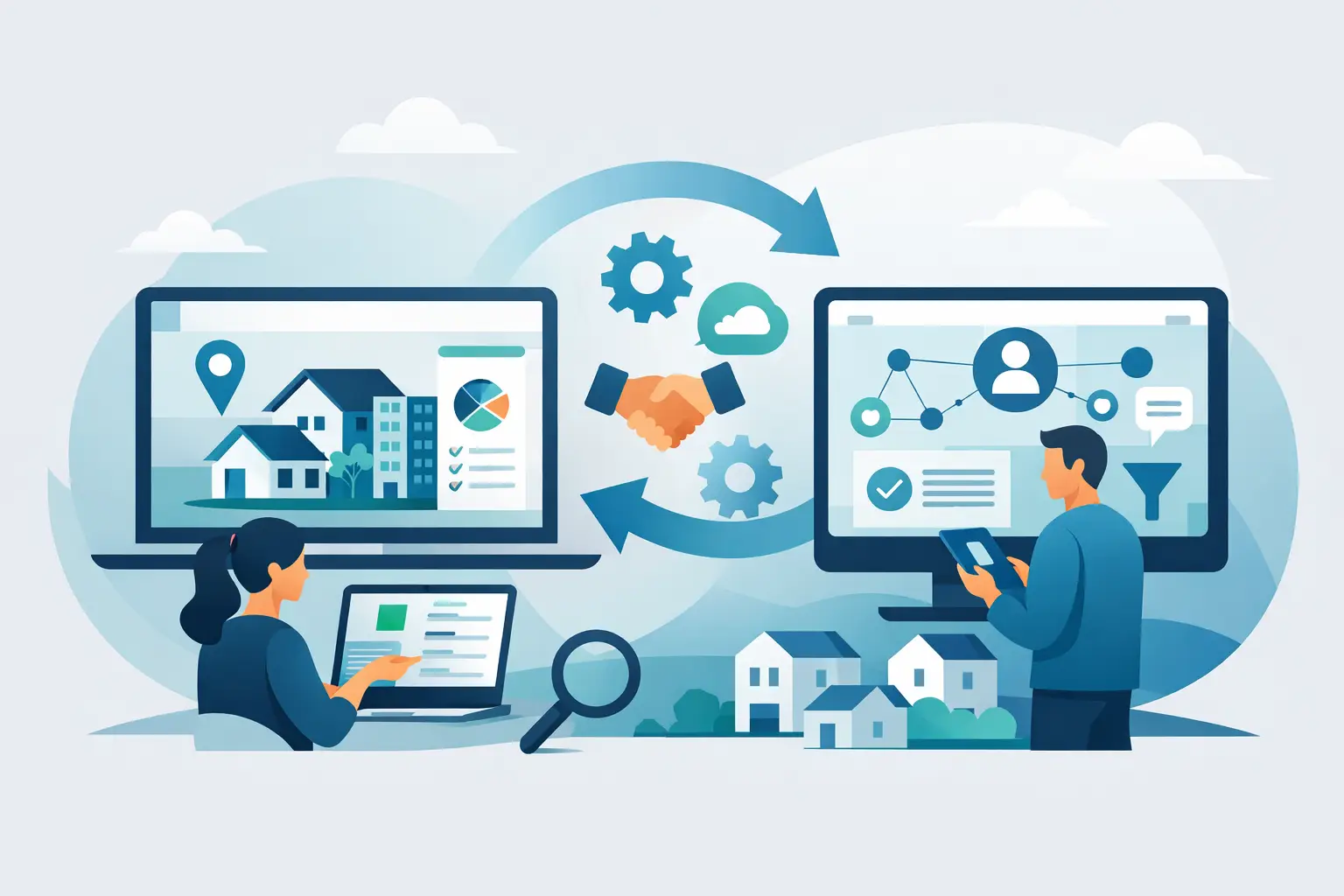
If your team is still copying updates from one system into another, property software CRM integration is not a nice-to-have. It is the difference between an operation that scales and one that keeps hiring just to stay afloat. For letting agents, block managers and portfolio landlords, the cost of disconnected systems shows up every day in missed follow-ups, duplicated work, delayed responses and poor visibility.
The real issue is not that most property businesses lack software. It is that they have too much of it, with too little connection between the parts that matter. A CRM holds core contact and property records. A finance system tracks rents, invoices and charges. Email, phone calls and maintenance updates sit elsewhere. Staff then spend hours stitching it all together by hand.
That model becomes expensive fast. Every manual handoff creates another chance for a task to be missed, a landlord to chase for an update, or a team member to work from the wrong information. Integration fixes that at the operational level.
What property software CRM integration should actually do
A lot of software suppliers talk about integration as if any data sync is enough. For property businesses, that is too narrow. Good property software CRM integration should reduce admin, improve response times and give staff a clearer operating picture without forcing a full system change.
At a practical level, this means your CRM remains the source of truth for contacts, properties and tenancy data, while connected software handles the work around it. Calls can trigger actions. Emails can feed shared communication records. Maintenance requests can create tasks automatically. Landlords can see updates without needing staff to send another manual report.
That matters because the pressure points in property operations are rarely caused by missing data fields. They are caused by repetitive processes around the data. When someone reports a repair, when a landlord asks for an update, when an incoming call needs logging, when a recurring task should have been created automatically - that is where time is lost.
Why disconnected systems create hidden costs
Most agencies do not notice the full cost of fragmented systems because the work gets absorbed by the team. One administrator spends 20 minutes chasing context before replying to a landlord. A property manager manually creates tasks after every call. An accounts colleague asks for an update that already exists, just not in the right place.
None of these issues look dramatic in isolation. Across a portfolio, they become a constant drain on margin.
The biggest hidden cost is context switching. Staff are less productive when they move between inboxes, CRMs, call notes, finance tools and spreadsheets to complete one job. The second cost is inconsistency. Different team members log information differently, which creates gaps in reporting and uneven service. The third is delay. Even a short lag between one system being updated and another being checked can affect landlord communication and internal decision-making.
This is why property software CRM integration is as much an operational decision as a technology one. It changes how work moves through the business.
Where integration delivers the fastest return
Not every integration project produces the same value. The best returns usually come from the workflows that happen every day and involve the most repetition.
For lettings, that often includes enquiry handling, maintenance reporting, landlord updates, task creation and communication logging. For block management, it may be contractor coordination, resident communication, recurring compliance workflows and visibility for directors or landlords. In both cases, the return comes from reducing manual touchpoints rather than simply syncing records.
A useful test is simple. Ask where your team repeats the same administrative action more than ten times a day. If a connected system can remove or automate that step, it is likely worth attention.
This is also where many businesses make the wrong comparison. They compare software cost against software cost. The better comparison is software cost against payroll time, delayed service and lost capacity. If integration saves several hours per person each week, it creates room for growth without adding headcount at the same pace.
Property software CRM integration without replacing your stack
One of the biggest barriers to change is the fear of disruption. Property businesses often assume integration means replacing their CRM, retraining the team and rebuilding established processes from scratch. In reality, the strongest approach is usually to keep core systems in place and add an operational layer around them.
That approach suits busy agencies because it avoids unnecessary upheaval. Your CRM continues to manage the records it already handles well. Your finance platform continues to manage financial data. The integrated layer then improves what happens between those systems - communication, workflow, automation and reporting.
This is especially useful for firms that have invested heavily in existing tools but still feel the day-to-day operation is slower than it should be. You do not always need a new core platform. Often, you need better orchestration.
For that reason, the best integration projects start with process mapping, not product demos. Before choosing anything, look at where work gets stuck, where updates are repeated and where stakeholders lack visibility. The software should then support that operating model, not force a new one that looks tidy on paper but frustrates staff in practice.
What to look for in an integrated property operations setup
A connected system should make life easier for three groups at once: your internal team, your landlords or clients, and your suppliers or contractors where relevant. If it only improves one side of the equation, the gain is limited.
For internal teams, the priority is speed and clarity. Staff need fewer manual steps, cleaner task flows and one shared view of communication. For landlords, the priority is visibility. They want timely information without chasing. For business owners and operations managers, the priority is control. They need to see workload, response times and portfolio activity without relying on ad hoc updates.
That means integration should support more than data transfer. It should support action. Can inbound communication create tasks automatically? Can conversations be tracked in a shared hub rather than scattered across personal inboxes? Can landlords see progress in real time rather than waiting for monthly reporting? Can routine enquiries be handled without pulling staff away from higher-value work?
If the answer is no, the integration may be technically functional but commercially underpowered.
A better question than "does it integrate?"
Most buyers ask software providers whether their system integrates with a CRM. That is too basic. The more useful question is what happens after the integration is live.
Does it remove real admin from the team? Does it cut response times? Does it reduce duplicate communication? Does it improve accountability? Does it help you manage more units with the same headcount?
There is also a trade-off to consider. Some integration setups are broad but shallow. They connect many systems but do little beyond passing data back and forth. Others are narrower but operationally stronger, automating the workflows that cost the business the most time. Which is better depends on your bottlenecks.
For many UK property firms, depth matters more than breadth. One well-integrated workflow that saves hours each week is often more valuable than ten superficial connections that change very little.
This is where a platform like Prop Report fits naturally. For businesses that already rely on established CRM and finance systems, the value comes from improving the operational layer around them - automating repetitive actions, centralising communication and giving landlords clearer visibility without creating another disconnected tool.
How to approach implementation without slowing the team down
The safest implementation is phased. Start with one or two high-friction workflows, measure the result, then expand. That keeps disruption low and gives the team evidence quickly.
A good first phase might be inbound communication handling and automated task creation. Those areas usually affect multiple staff members and produce immediate time savings. Once that is working well, landlord reporting, maintenance updates or dashboard visibility can follow.
It also helps to set clear success measures from the start. Track hours saved, response times, volume of manual tasks removed and the number of landlord chases reduced. If the project is framed only as a system upgrade, the benefits can feel vague. If it is framed as an operational efficiency programme, the commercial impact is easier to prove.
Internal adoption matters too. Teams will use connected software properly if it removes effort from their day, not if it adds another compliance task. The interface, workflow design and quality of automation all influence this. The best systems do not ask staff to become better administrators. They reduce the amount of administration required.
Property operations do not get easier as portfolios grow. Communication increases, task volume rises and expectations from landlords remain high. The businesses that cope best are not necessarily the ones with the most staff or the largest software budget. They are the ones that design better systems around the work.
That is the real case for property software CRM integration. Not more technology for its own sake, but fewer gaps, less repetition and a business that can respond faster without losing control. If your current setup still depends on people acting as the link between systems, that is probably the next problem worth fixing.