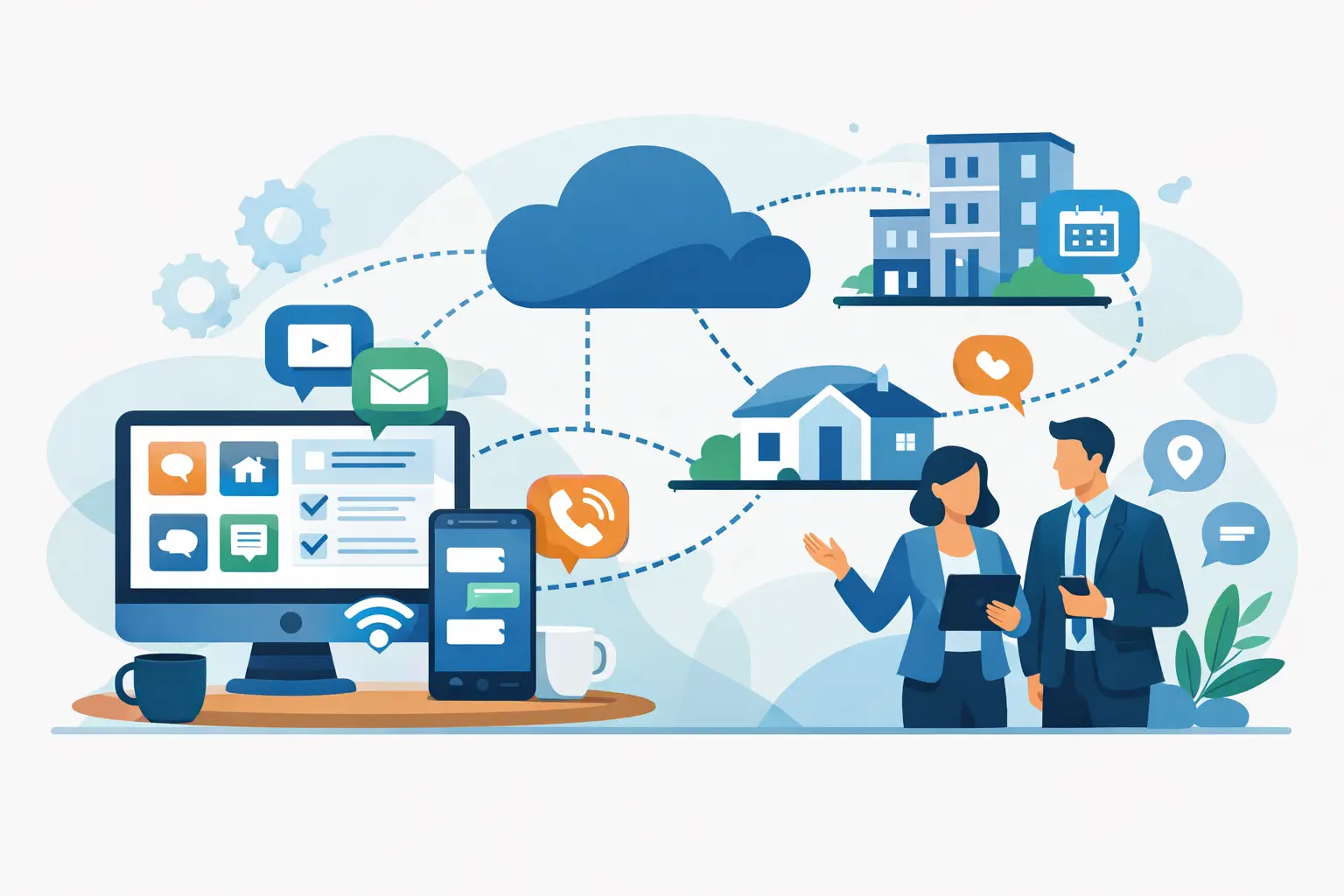
A missed voicemail about a leak, a contractor update sitting in someone’s inbox, and a landlord asking for progress can quickly become three separate admin jobs. Property communications hub software gives letting agents, block managers and portfolio landlords one place to handle those conversations, keep ownership clear and turn messages into accountable work.
The objective is not simply to store correspondence. It is to reduce the time your team spends chasing information, copying updates between systems and working out who promised what. When communication is connected to the property, stakeholder and task, the portfolio is easier to control.
Why property communication breaks down
Most property businesses do not struggle because their people are unresponsive. They struggle because the information needed to respond is fragmented. Calls arrive at reception, emails land in individual inboxes, maintenance updates appear in a contractor portal and messages are exchanged through personal mobiles. By the time someone needs a clear answer, the team is searching across four places.
This creates a familiar operational cycle. A tenant reports an issue, an administrator forwards it, a property manager raises a task manually, a contractor replies to a different email address, and a landlord requests an update that has to be assembled from scratch. Every handover introduces delay and the risk of a missed action.
For a small portfolio, this may be inconvenient. Across hundreds of managed properties, it becomes a direct cost. A few minutes spent locating context, writing status updates and checking whether an action has been completed can consume hours every week. It also makes service inconsistent. The answer a caller receives can depend on which member of staff happens to pick up.
A communications hub addresses this by making the conversation part of the workflow, rather than a separate activity that staff must remember to document later.
What property communications hub software should do
The right platform should create one operational view of communication without demanding that you replace your CRM, property management system or finance software. For most established agencies and block management firms, that integration point matters. Replacing a core system is expensive, disruptive and rarely necessary when the real issue is the operational work happening around it.
A useful hub brings incoming and outgoing communication into a shared environment, linked to the relevant property, tenancy, landlord, leaseholder or maintenance case. Your team should be able to see the latest contact, the current status and the next action without relying on one person’s memory or mailbox.
It should also turn communication into action. If a tenant calls about a repair, the detail should be captured and routed to the right person or workflow. If a contractor confirms attendance, the relevant task should update. If a landlord needs visibility, they should be able to access a clear record rather than emailing the office for a progress report.
This is where automation earns its place. Automated task creation, reminders and escalation rules do not replace property expertise. They remove the repetitive admin surrounding it, so experienced staff can focus on judgement, resolution and client relationships.
Calls should lead somewhere
Telephone calls remain central to UK property operations, particularly for urgent maintenance issues and residents who want a direct response. Yet calls are often the least structured channel. Notes may be incomplete, messages may be passed verbally, and the person who takes the call may not have access to the full property history.
AI call handling can provide a more controlled first response, capture the reason for contact and create the appropriate follow-up. It is not the right answer for every situation. Complex disputes, vulnerable residents and sensitive landlord discussions require a capable person. But for routine enquiries, status requests and clearly defined triage, it can protect staff time while ensuring a request does not disappear into a handwritten note.
Shared visibility changes the landlord experience
Landlords do not necessarily need more emails. They need confidence that their properties are being managed properly. A real-time dashboard can show maintenance activity, communication history, outstanding actions and relevant reporting without adding to the property manager’s inbox.
That transparency reduces avoidable chasers and helps agencies demonstrate value beyond rent collection or basic administration. It also creates a more productive conversation when an issue does need discussion. Both sides can start with the same facts, rather than spending the first ten minutes establishing what has happened.
The operational gains come from connected workflows
The strongest property communications hub software does not treat messages, tasks and reporting as separate modules. It connects them. A new contact triggers a process, the process assigns responsibility, updates remain visible to the right stakeholders, and completed work feeds into the management record.
Consider a blocked drain at a managed block. A resident reports it by phone. The call is logged against the building, a task is created for the correct team, the contractor receives the required details and the manager can see whether attendance has been confirmed. Updates can be shared without rebuilding the story in every email. If a leaseholder or client asks for progress, the information is already organised.
That workflow is more valuable than a shared inbox alone. A shared inbox tells you that someone wrote in. A connected hub tells you what the issue is, who owns it, what must happen next and whether the commitment has been met.
The same principle applies to lettings. Referencing queries, renewal conversations, arrears follow-up and repair requests all involve repeatable stages. The precise workflow will vary by agency, and it should. A growing lettings business may prioritise speed of response and task allocation, while a block manager may need deeper visibility across contractors, directors, leaseholders and compliance work. The platform should support those differences without creating a new manual process for every exception.
How to introduce a communications hub without adding complexity
The first step is not to migrate every historic email. Start with the high-volume, high-friction processes where poor communication is costing the most time. Maintenance triage, inbound calls and landlord updates are often sensible starting points because the impact is visible quickly.
Map the current process honestly. Identify where a message changes hands, where staff rekey the same information and where nobody is certain who owns the next step. These are the points where automation and shared communication can remove waste.
Then define ownership. A hub works best when each workflow has a named team or role responsible for progressing it. Automation can assign tasks and send reminders, but it cannot resolve uncertainty about who should make a decision. Clear service standards still matter, especially for urgent repairs and complaints.
Integration should be practical rather than ambitious for its own sake. Connect the systems that hold the information your team needs every day, such as your CRM and finance platform. Avoid creating duplicate records or asking staff to update two places. The operational layer should reduce effort, not become another destination that must be checked manually.
Finally, measure adoption in terms that matter to the business. Track response times, outstanding tasks, repeat chasers, calls handled, maintenance turnaround and the time spent producing landlord updates. If a new process has not reduced admin or improved visibility, adjust it. Software should support the operation you want to run, not force the team to preserve an inefficient one.
Better communication is a control system
For property professionals, communication is not a soft service metric. It is the record of decisions, the trigger for work and the evidence that clients expect when they ask how their property is being managed. When it is scattered, managers lose time and leaders lose visibility.
Prop Report is designed to provide that operational layer: bringing calls, tasks, communication and reporting into a clearer workflow while working alongside the systems you already rely on. The result is not more software for your team to manage. It is fewer loose ends, faster follow-up and a portfolio that is easier to run with confidence.
The most useful test is simple: when a landlord, tenant or contractor contacts your business, can any authorised colleague see the context and take the right next action? If the answer is not consistently yes, the opportunity is not just better communication. It is a better controlled operation.