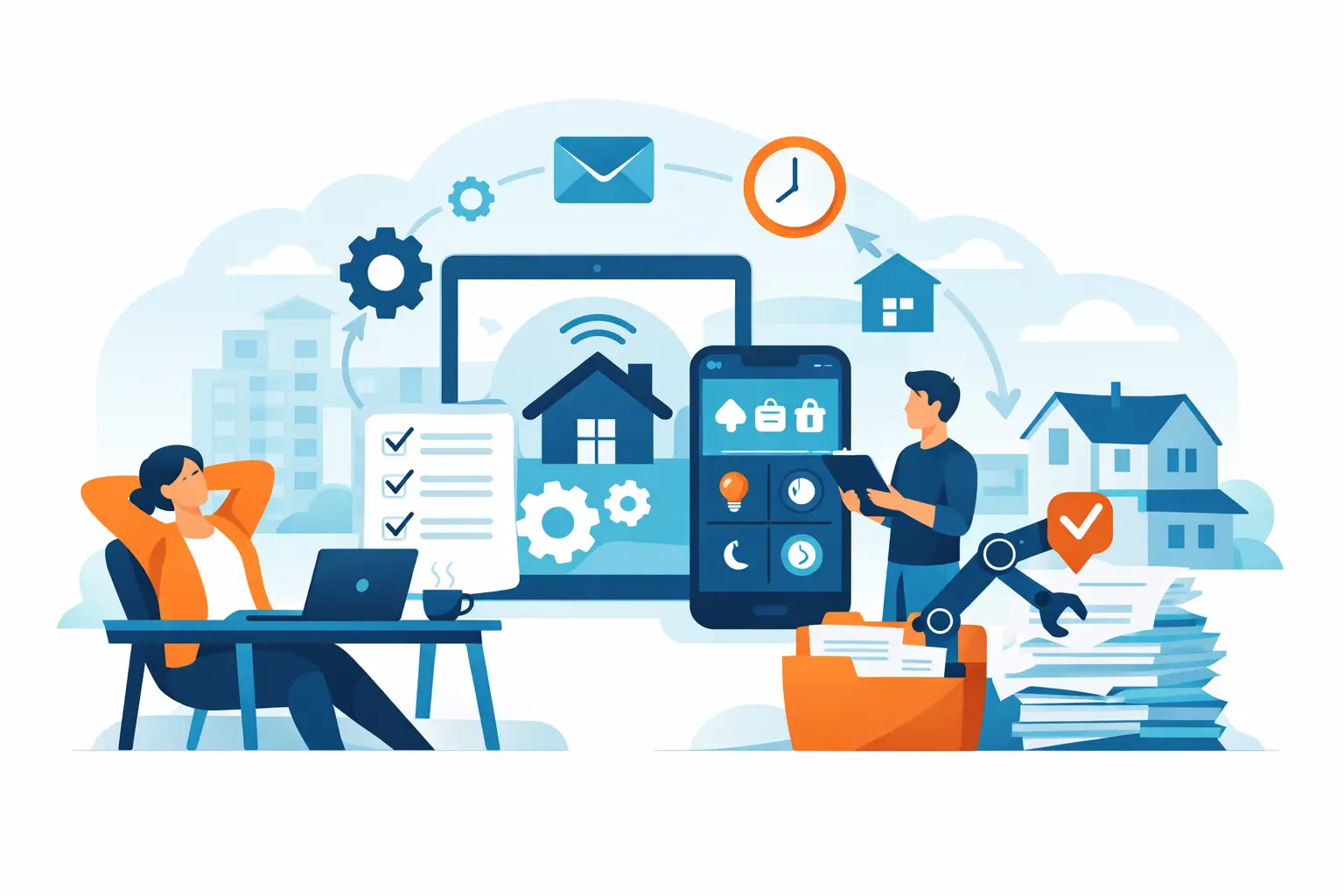
At 9:12am, a property manager receives three calls about the same issue: a tenant wants an update, the landlord wants reassurance and a contractor needs access details. In many agencies, that creates three separate notes, several chaser emails and a task that may never reach the right person. This property automation case study looks at what changes when those routine hand-offs are managed by a connected operational layer rather than individual inboxes.
The scenario is representative of a UK lettings and block management business with a growing portfolio, a lean operations team and established CRM and finance systems it does not want to replace. The aim is not to automate relationships out of property management. It is to remove the repetitive work that stops experienced people from managing those relationships properly.
The operational problem behind the admin
The business manages 850 units across residential lettings and blocks. Its team is capable and responsive, but its working day is dominated by avoidable administration: logging calls, forwarding emails, chasing updates, creating tasks, checking repair progress and responding to landlords who cannot see what is happening without asking.
The pressure is particularly visible around maintenance. A repair might begin as a voicemail, become an email to a contractor, then a note in the CRM and finally a reminder in somebody's personal task list. Each step is reasonable on its own. Across hundreds of requests, however, the process creates delays, duplicated records and unclear ownership.
Management initially framed the problem as a staffing issue. The numbers suggested something different. The team did not simply need more people. It needed a better way to capture requests, direct work and make progress visible.
A useful baseline exercise showed that six administrators and property managers were collectively spending around 70 hours a week on tasks that followed a predictable pattern. This included call logging, task creation, internal updates, landlord chasers and status reporting. Even a partial reduction would create meaningful capacity without increasing headcount.
Property automation case study: redesigning the workflow
The agency chose to add automation around its existing systems, rather than run a lengthy replacement project. Its CRM remained the source of record for property and contact data, while its finance platform continued to manage rent and accounting information. The new operational layer focused on the work between those systems: communication, tasks, reporting and visibility.
The implementation started with three high-volume workflows. This mattered. Trying to automate every exception at once would have slowed the project and made it harder for the team to trust the new process.
1. Calls became recorded actions, not forgotten messages
AI call handling was configured to capture routine incoming calls, identify the nature of the request and create a structured summary. Where a caller reported a repair, requested an update or asked for a document, the relevant information was captured consistently and routed to the correct queue.
The point was not to force every caller through an impersonal system. Urgent, complex and sensitive calls still needed a person. But a large share of incoming traffic involved straightforward requests that could be logged accurately before a team member intervened.
Each call record created a visible trail. Staff could see what the caller needed, what had already been said and which action was due next. That reduced the familiar problem of a tenant calling twice because the first conversation lived only in a colleague's memory.
2. Tasks were created at the point of contact
Previously, a member of staff had to read an email or listen to a voicemail, decide what mattered, create a task and assign it. Under the new workflow, defined triggers created tasks automatically. A maintenance request could generate an action for the property manager, a contractor follow-up and a timed reminder if no update arrived.
Rules were deliberately practical. They used property, issue type, urgency and team responsibility to direct work. For example, a water leak could be escalated immediately, while a routine query about a statement could be assigned to the accounts queue with an appropriate service target.
Automation does not remove the need for judgement. It gives the team a reliable starting point. Staff still decide whether a reported issue is genuinely urgent, whether a contractor's estimate is acceptable and how a difficult landlord conversation should be handled. The difference is that these decisions happen with the information and ownership already organised.
3. Landlords stopped chasing for basic updates
The agency also introduced real-time landlord dashboards. Rather than compiling progress reports manually or replying to individual messages, staff could give landlords a clearer view of open issues, completed actions and relevant property activity.
That transparency changed the quality of communication. Landlords were less likely to ask, "Has anyone seen this?" and more likely to ask a specific, useful question about the next step. The team spent less time producing status updates and more time resolving the issues that needed intervention.
There is a balance to strike. A dashboard should provide visibility, not invite unnecessary operational interference. The most useful setup shares clear status, timestamps and outcomes, while keeping sensitive internal commentary and commercial decision-making within the agency.
What changed after the first 90 days
In this representative model, the agency did not claim that automation eliminated administration. It did reduce the volume of low-value handling and made the remaining work easier to manage.
The operations manager tracked four measures: hours spent on manual logging and chasing, response times for new requests, the number of overdue tasks and the volume of landlord status enquiries. Within 90 days, manual handling time on the selected workflows fell by an estimated 35 to 45 per cent. The range matters because performance varies by team adoption, data quality and the complexity of the portfolio.
For a business previously spending 70 hours a week on repetitive work, a 40 per cent reduction represents roughly 28 hours returned to the team each week. That capacity can be used in different ways: improving inspection follow-up, managing arrears conversations, supporting growth or reducing reliance on temporary cover during peak periods.
The less obvious improvement was accountability. When a task had a clear owner, due date and communication history, managers could identify bottlenecks without relying on a daily round of "who is dealing with this?" messages. A contractor delay, an unassigned query or a recurring property issue became visible early enough to address.
Why integration mattered more than another dashboard
Property businesses rarely suffer from a total absence of software. More often, they have several systems that each hold part of the picture. Adding a disconnected tool can create another place to check and another process for staff to remember.
That is why the operational layer needs to work with existing CRM and finance systems. Property information, contact details and financial context should not need to be re-entered simply because a task or call has been created. The practical test is straightforward: does the new workflow reduce handling, or does it create another administrative loop?
For this agency, integration meant staff could act from shared information without abandoning the platforms already embedded in the business. It also reduced resistance to change. The team was not being asked to learn a new way to manage every aspect of a tenancy or block. It was being given a more controlled way to manage the work that sits between systems.
The trade-offs that should be planned for
Automation produces better results when the underlying process is clear. If every property manager uses different categories, priorities and contractor rules, automated routing will only reproduce the inconsistency faster. Before configuring workflows, the agency agreed standard issue types, ownership rules and escalation points.
There is also a risk of over-automation. A generic acknowledgement may be useful for a routine query, but it is not an adequate response to a distressed tenant reporting a serious issue. The best property workflows identify where speed and consistency help, then reserve human attention for the moments that require judgement, empathy or commercial negotiation.
Data discipline is equally important. Contact records, property associations and task statuses need to be accurate. This is not glamorous work, but it determines whether automated actions reach the right person and whether landlord reporting can be trusted.
Turning saved time into better service
The value of property automation is not measured only by fewer clicks. It is measured by whether the business becomes easier to run as the portfolio grows. When communication is captured, tasks are created consistently and landlords can see meaningful progress, the team has more control over the day rather than reacting to it.
For agencies and block managers assessing this approach, start with the work that creates the most repeat contact and internal chasing. Measure its current cost, agree who should own each action and automate one workflow well before expanding. Platforms such as Prop Report are designed to provide that operational layer while preserving the systems your business already relies on.
The strongest result is not a quieter inbox for its own sake. It is a team with the time and visibility to deal with the call at 9:12am properly the first time.