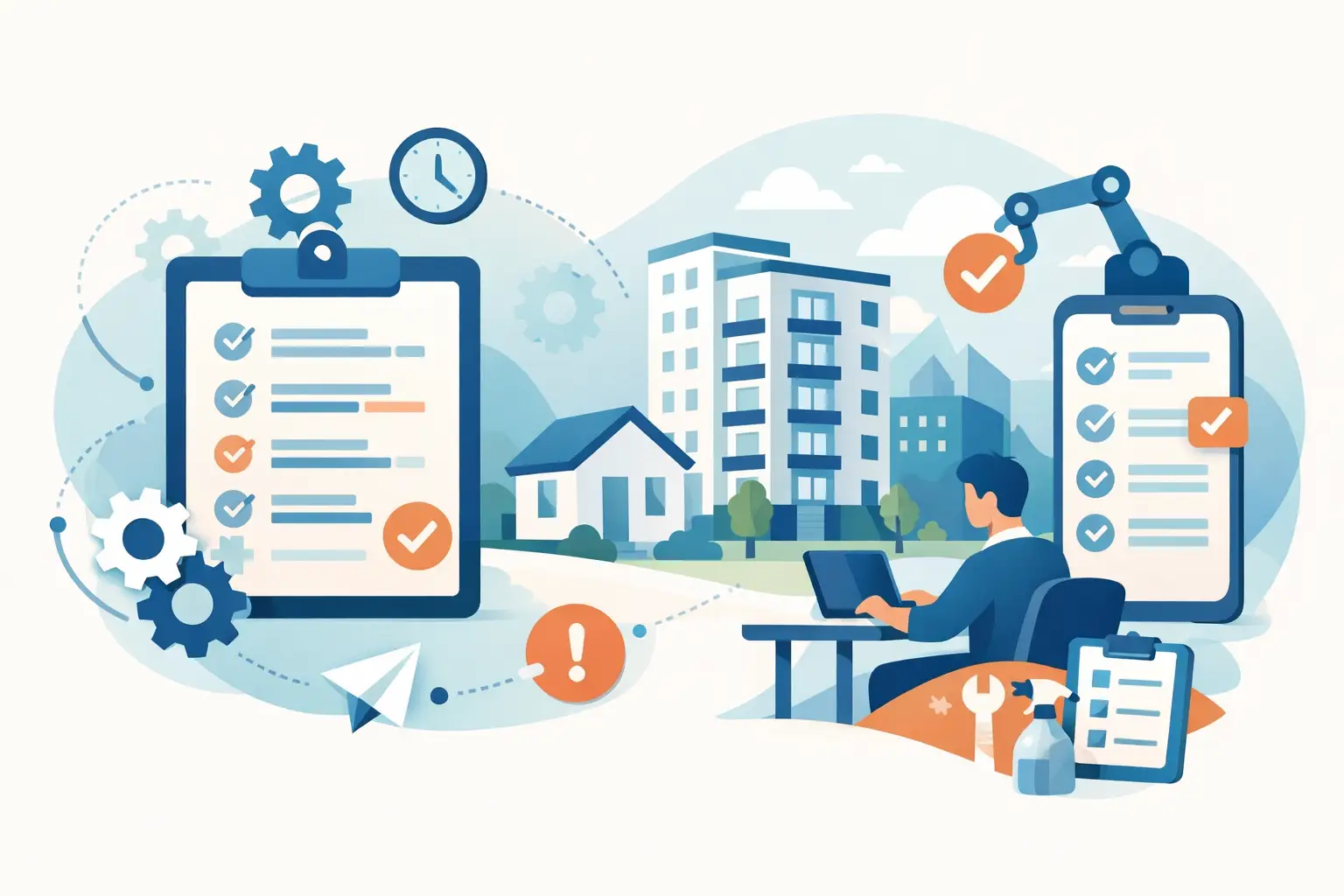
At 4.45 pm on a Friday, a contractor update lands by email, a tenant leaves a voicemail about a leak, and a landlord asks for progress on an outstanding repair. None of these jobs is unusual. The problem is what happens next when each item has to be read, interpreted, logged, assigned and chased manually. Automated task creation for property management changes that part of the day. It removes the delay between an issue being reported and the right action being set in motion.
For busy letting agents, block managers and portfolio landlords, that delay is expensive. It leads to missed follow-ups, duplicated effort, patchy communication and teams spending too much time moving information between inboxes, spreadsheets and systems. The real value of automation is not that it creates more tasks. It creates the right tasks, at the right time, with the right context, so work moves without someone having to push every step forward.
Why automated task creation matters in property operations
Property management runs on repeatable workflows. Maintenance issues, compliance deadlines, tenancy milestones, contractor updates, landlord queries and resident communications all trigger actions. When those actions are handled manually, performance depends too heavily on individual memory and inbox discipline.
That creates risk in two directions. First, service quality slips because jobs sit unassigned or updates are not passed on quickly enough. Second, operational cost rises because skilled staff spend hours on admin that adds little value. If a property administrator is repeatedly logging the same kinds of jobs every day, that is not a staffing problem. It is a workflow problem.
Automated task creation for property management is most effective where work is high volume and rules-based. If a repair request mentions a leak, the system can generate a maintenance task, assign priority, notify the right team member and attach the original communication. If a compliance date is approaching, it can create a follow-up before the deadline becomes urgent. If a landlord asks for an update, the relevant task history can already be in place rather than being rebuilt from scattered messages.
This is where automation becomes commercially useful. It reduces labour spent on routine triage, shortens response times and gives managers clearer oversight of what is open, overdue and resolved.
What good automated task creation looks like
There is a big difference between basic automation and operationally useful automation. Basic automation might create a generic job every time an email arrives. That sounds efficient until your team is sorting through irrelevant or duplicate tasks.
Good automation is selective and structured. It recognises triggers, applies rules and routes work in a way that matches how property teams actually operate. That usually means pulling tasks from multiple sources such as calls, emails, logged issues, recurring dates and internal updates.
The strongest setups tend to include three things. First, context. A task should carry the property, tenancy, block, contact and communication history with it. Second, ownership. The task should be assigned to the right person or team automatically, not left in a shared queue for someone to pick up later. Third, visibility. Managers and landlords need to see progress without chasing staff for manual updates.
That matters especially in block management and larger lettings portfolios, where one issue can involve residents, contractors, property managers and clients at the same time. Without a shared operational view, task creation alone just moves the mess into another system.
The best workflows start before the task exists
Most admin teams do not struggle because they cannot create tasks. They struggle because information arrives in too many formats and no one has time to standardise it. Voicemails, inbound calls, email chains and ad hoc messages all need to become trackable work.
This is why the source of the task matters. If incoming communication can be interpreted and converted into structured actions automatically, the team avoids the bottleneck at the front end. A reported maintenance issue should not wait for someone to listen to a message, write notes and retype the details elsewhere before action begins.
Where automation delivers the biggest return
The clearest gains usually come from the parts of the operation that are repetitive, time-sensitive and easy to define.
Maintenance is the obvious example. A large share of incoming communication relates to repairs, access arrangements, contractor updates and progress chasing. Automating task creation here reduces response lag and makes it easier to prioritise urgent issues. It also cuts the back-and-forth that happens when one team member logs the issue, another assigns it and a third updates the landlord.
Compliance is another strong use case. Gas safety checks, EICRs, inspections and policy renewals all follow dates and rules. Manual tracking works until portfolio size increases or staff capacity tightens. Automated tasks help prevent deadline drift and create a cleaner audit trail.
Then there are tenancy and resident lifecycle events. Move-ins, move-outs, deposit actions, renewals and end-of-tenancy issues all involve predictable sequences. If those tasks can be created automatically based on milestones, teams spend less time building the same checklist again and again.
For agency leaders, the financial case is straightforward. If automation removes several minutes from hundreds of tasks each month, the saving compounds quickly. More importantly, it frees experienced staff to handle exceptions, resolve problems faster and provide a better client experience.
The trade-offs to think about
Automation is not a licence to remove judgement. Property management still involves nuance. Not every repair request is urgent, not every resident complaint fits a preset category, and not every landlord wants the same level of reporting.
That means rules need to be designed carefully. If your system creates too many tasks, teams stop trusting it. If it applies the wrong priority, response quality can suffer rather than improve. Good automation should reduce decision-making where the answer is obvious and preserve human control where context matters.
There is also an integration question. Many property businesses already rely on established CRM and finance systems. Replacing them is rarely attractive. The better approach is usually to add an operational layer that works with the tools already in place and improves workflow around them. That keeps disruption lower and speeds up adoption.
Change management matters as well. Staff need to understand why tasks are being created, where they appear, who owns them and how progress is updated. Even the best automation will underperform if the team treats it as an extra inbox rather than the main workflow.
How to implement automated task creation for property management
Start with one process that is high volume and easy to measure. Maintenance triage is often the right choice because the workload is constant and the impact is visible quickly. Map how issues currently come in, who logs them, how they are assigned and where delays happen. That shows where automation will remove the most friction.
Next, define the rules. Decide which triggers should create tasks, what information should be attached, how priority should be set and who should receive the work. Keep the first version simple. It is better to automate one common workflow well than five workflows badly.
Then look at reporting. If you cannot see how many tasks were created automatically, how quickly they were picked up and how long they took to resolve, you cannot prove the value. Operational leaders need evidence, not just a sense that things feel faster.
Finally, think about the experience beyond the internal team. When task automation is connected to shared communication and landlord reporting, the gain is bigger. Staff spend less time writing status updates manually, and clients get better visibility without having to chase for answers. That is where systems start to improve both margin and service at the same time.
For many firms, this is why platforms such as Prop Report are gaining traction. The attraction is not automation for its own sake. It is the ability to reduce repetitive admin, keep communications organised and give landlords a clearer view of what is happening across their portfolio without ripping out existing core software.
Automated task creation is only valuable if it improves control
The headline benefit is time saved, but the deeper benefit is better control. When work is created automatically from real operational events, nothing important depends on someone remembering to log it later. Teams can see what is moving, managers can spot bottlenecks earlier and landlords receive a more consistent service.
That does not mean every workflow should be automated. It means the repetitive parts should be, so your team has more capacity for the work that actually needs expertise. In property management, that is usually the difference between constantly reacting and running a tighter operation.
If your current process still depends on inbox scanning, manual handovers and end-of-day catch-up, the issue is not effort. It is system design. The businesses that gain ground over the next few years will be the ones that treat admin reduction as an operational strategy, not just a productivity tweak. A better workflow does more than save minutes. It gives your team room to manage the portfolio properly.