A tenant calls at 8.15am about a boiler that has stopped working. A landlord rings at lunchtime to ask why a repair has not progressed. A contractor calls while your team is in a viewing. If each caller reaches voicemail, the real work begins later: listening back, interpreting the message, deciding urgency, finding the right person and updating the system.
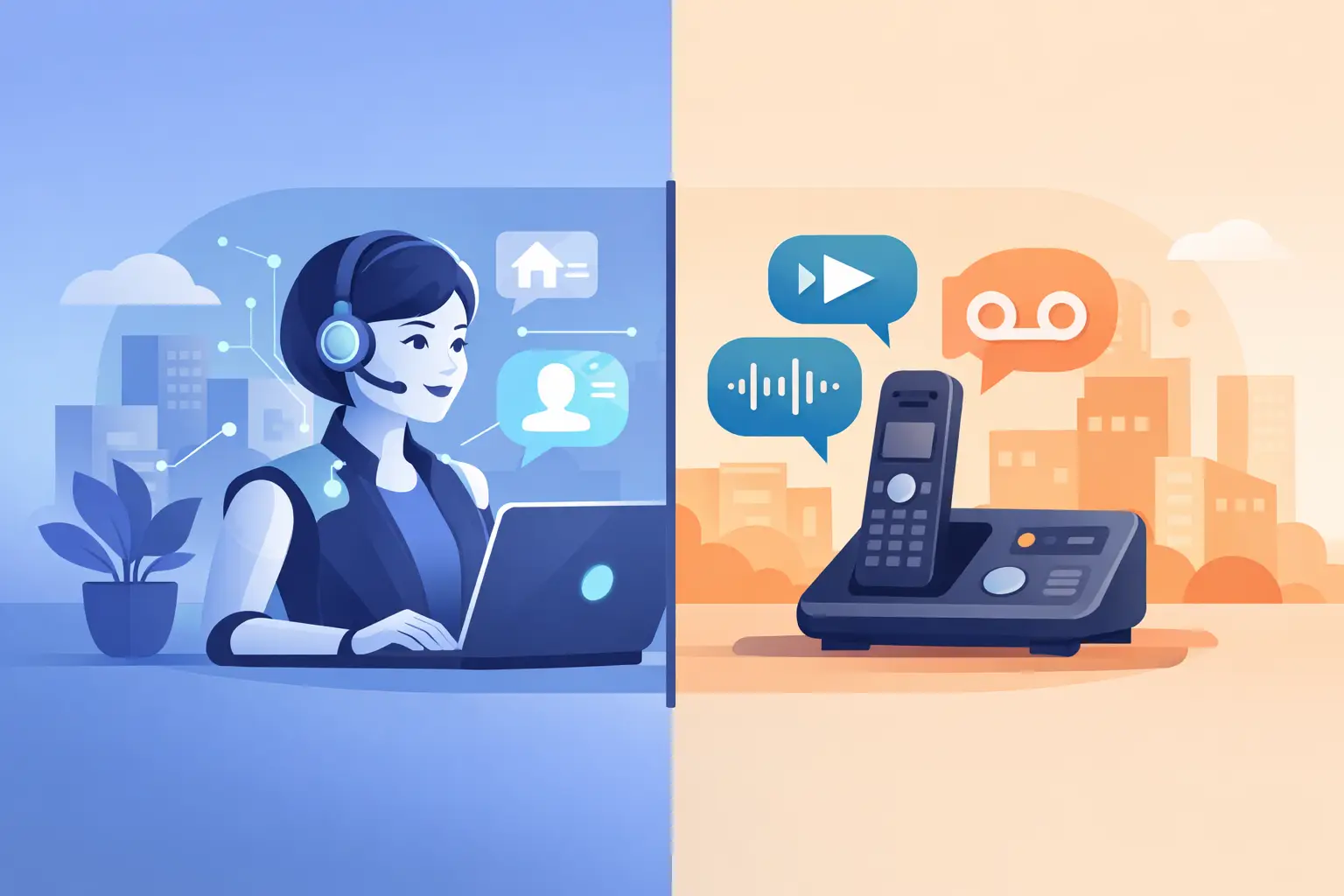
That is the operational difference at the centre of AI receptionist vs voicemail. Both can answer when your team cannot. Only one can turn a call into an organised next step while the conversation is still fresh.
For letting agents, block managers and portfolio landlords, this is not simply a question of sounding more available. It is about controlling a high-volume communication channel without adding more administration to an already stretched team.
AI receptionist vs voicemail: the practical difference
Voicemail records a message for somebody to deal with later. It has a place as a basic fall-back, particularly for small teams with low call volumes or clearly defined office hours. But it creates a queue of unstructured work. The caller must explain the issue, often without knowing what information matters, and a member of staff must replay it before acting.
An AI receptionist holds an initial conversation. It can identify who is calling, understand the broad reason for the call, collect key details and route or log the enquiry according to your rules. For a property business, that might mean capturing a property address, distinguishing a routine maintenance request from an emergency, recording a contractor query or passing a prospective tenant to the correct team.
The distinction matters because property calls are rarely just messages. They are requests, updates, risks and deadlines. A missed call about a leak, access issue or compliance document needs more than a timestamp and a short recording.
Voicemail delays the workflow
A voicemail inbox can look manageable at 9am and become a problem by midday. Staff may be handling viewings, inspections, arrears, repairs and walk-in enquiries. Messages are played back in batches, details are written down or copied into a CRM, and callbacks happen when capacity allows.
That delay has a cost. Tenants may call repeatedly. Landlords may chase because they have no visibility of progress. Team members can duplicate work when a message has been heard by one person but not logged centrally. The business appears less responsive even when staff are working hard.
Voicemail also relies on callers giving useful information first time. A tenant might say, “There is a problem with the heating,” without the property reference, the nature of the fault or whether vulnerable occupants are affected. The follow-up call then becomes an information-gathering exercise before the actual task can begin.
An AI receptionist starts the workflow
A well-configured AI receptionist can ask the questions your team would ask at the start of a call. It can collect the caller’s name, property details, contact number and reason for calling, then create a clear record for the appropriate person or process.
For example, a maintenance call can be classified and passed into an organised workflow with the relevant notes. A routine enquiry can be logged for follow-up. A serious issue can be escalated against agreed rules. Instead of someone listening to recordings and manually creating tasks, the team begins with usable information.
This does not mean every call should be handled without people. Complex complaints, sensitive tenancy matters, major incidents and relationship-led landlord conversations often need an experienced member of staff. The value is that the AI receptionist filters, captures and directs the predictable work, protecting the team’s time for calls where judgement genuinely matters.
Where voicemail still makes sense
Voicemail is not automatically the wrong choice. A sole landlord with a handful of properties may prefer a simple recorded message if calls are infrequent and they can reliably return them within a short period. It is inexpensive, familiar and requires almost no setup.
It can also work as a secondary safety net. If an agency has a dedicated out-of-hours emergency provider or a reception team during office hours, voicemail may be appropriate for non-urgent calls outside those arrangements.
The issue comes when voicemail is being used to manage scale. If several staff members spend part of every day listening, transcribing, forwarding and chasing messages, the apparent saving disappears. The business is paying for the process through admin time, slower response times and lost context.
A useful test is simple: can your team see, at any moment, which missed calls have been actioned, who owns the next step and what the caller was told? If the answer depends on checking personal inboxes, handwritten notes or individual memories, voicemail is creating an operational blind spot.
What property teams should measure
The right decision should be based on workload, not novelty. Before changing call handling, look at a typical month of missed and incoming calls. Measure how many result in a task, how long it takes to return them, how often callers chase, and how much staff time is spent turning conversations into records.
For most agencies, the strongest case for an AI receptionist is not that it answers every question perfectly. It is that it reduces the number of calls that need manual triage. Even saving a few minutes on each enquiry can release substantial capacity across hundreds of calls a month.
Consider the wider effect too. Better call capture improves reporting. If repair requests, landlord queries and tenant concerns are consistently categorised, managers can spot recurring issues, workload peaks and service gaps. That is difficult when valuable detail sits inside audio files or is never recorded at all.
For portfolio landlords, structured call handling also supports accountability. They want confidence that tenants can report issues, that their managing agent has a record of what was said and that progress can be checked without repeatedly asking for updates.
The risks of a poorly implemented AI receptionist
An AI receptionist is only as useful as the process behind it. Generic scripts, unclear escalation rules and no connection to the systems your team already uses will frustrate callers and create another inbox to monitor.
Property businesses should configure it around real call types, not abstract categories. Emergency maintenance needs a clear route. Viewing enquiries need a practical next action. Existing tenants should not be forced to repeat information that is already available. Landlord calls should be captured with enough context for the property manager to respond properly.
Tone matters as well. Callers should know they are speaking with an automated service, but the experience should remain clear and helpful. The aim is not to hide automation. It is to give people a quicker route to the right outcome.
Integration is equally important. If call notes and tasks sit apart from your CRM, maintenance process or communication hub, staff still have to transfer information manually. The best operational setup is one where a call creates useful activity in the same place the team already manages work. Platforms such as Prop Report are designed around this principle: automation should reduce system hopping, not add to it.
Choosing the right model for your agency
The choice is not always AI receptionist or voicemail in isolation. Many property teams need a layered approach. An AI receptionist can manage common enquiries and capture essential details, while urgent issues follow an escalation path and complex calls reach a person. Voicemail can remain as a final back-up rather than the main mechanism for dealing with missed demand.
Start with your busiest pain point. If maintenance messages are inconsistent, build that call flow first. If front-of-house staff are interrupted by constant supplier and viewing calls, focus on routing and task creation. A targeted rollout is easier to test, refine and adopt than changing every call process at once.
Ask the people who deal with calls what information they repeatedly chase. Their answers should shape the questions the AI receptionist asks. Then review the first weeks of data: missed-call volumes, response times, repeat callers, tasks created and cases that required human intervention. That gives you a practical basis for improving the setup.
Voicemail gives callers somewhere to leave a message. An AI receptionist gives your operation a way to act on it. For property teams under pressure to do more without increasing headcount, the better choice is usually the one that turns each call into visible, owned work before it becomes another item on somebody’s to-do list.