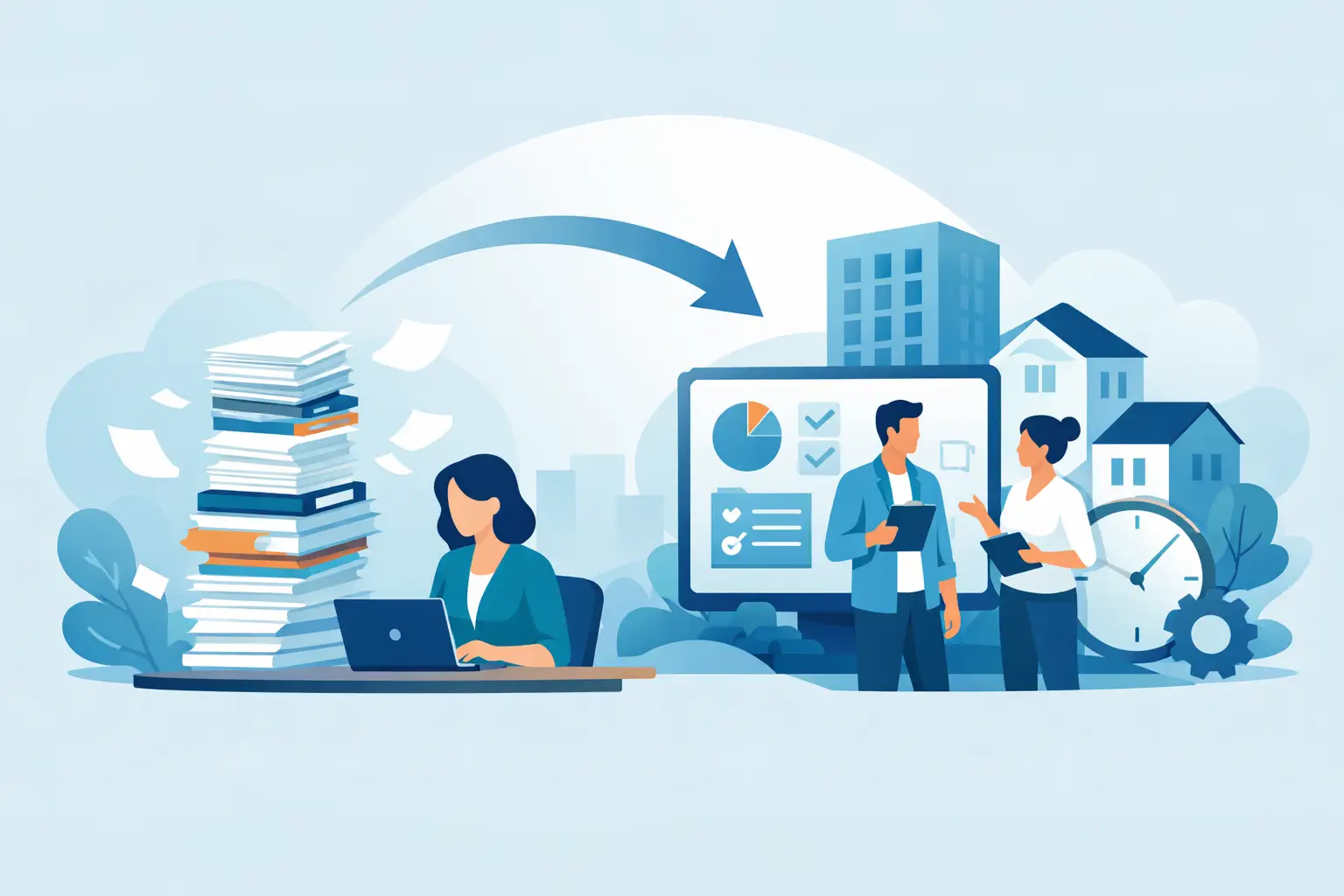
A maintenance query arrives by phone, a landlord asks for an update by email, and a contractor confirmation lands in a colleague’s inbox. None of these tasks is difficult on its own. Across a busy portfolio, however, the manual chasing, logging and updating quickly becomes the day’s work. Effective admin reduction for property teams is about removing that repeat handling without losing oversight, service quality or accountability.
For UK letting agents and block managers, the pressure is rarely caused by one large operational failure. It comes from hundreds of small interruptions: calls that need recording, messages that need forwarding, jobs that need assigning and landlords who need an answer now. When those actions sit across inboxes, spreadsheets, phone notes and core systems, teams spend too much time proving what has happened instead of progressing the next task.
Why property admin expands so quickly
Property management is communication-heavy by nature. A single repair can involve a tenant, contractor, property manager, landlord and finance team. In block management, a report from a leaseholder may also need input from a managing agent, board member or supplier. Every handover creates another opportunity for duplicated updates, missed context and avoidable follow-up.
The problem is compounded when the team’s main CRM or finance platform holds essential records but cannot manage every incoming conversation or trigger the right operational actions. Staff then create their own workarounds. They copy information into emails, set reminders manually, ask colleagues for status updates and build separate trackers to keep control.
That may work while a portfolio is small or a team has spare capacity. It does not scale well. As instructions grow, the hidden cost is not merely more admin hours. It is slower response times, inconsistent service, frustrated staff and managers with limited visibility of where work is stuck.
Admin reduction for property teams starts with the workflow
Buying software does not automatically reduce workload. The first step is to identify where information arrives, who acts on it and what must happen next. The highest-value opportunities are usually not dramatic process changes. They are the repeatable actions that occur every day and demand the same decisions from experienced people.
A useful test is simple: if a colleague receives a request and immediately has to log it, categorise it, assign it, notify someone and set a reminder, the process is a strong candidate for automation. The person should still make judgement calls where they matter. The system should handle the administrative chain around them.
Turn calls and messages into accountable work
Phone calls remain a major source of unstructured admin. A tenant may report a leak while the property manager is in a meeting. A landlord may chase a certificate, or a contractor may call to rearrange attendance. If the call is answered but the detail is not captured properly, the team starts the next conversation without a reliable record.
AI call handling and shared communication tools can record the reason for contact, capture key details and create a task for the appropriate person. This does not mean every conversation should be treated identically. Urgent repairs need escalation rules; routine update requests may be routed to a standard response process. The gain comes from ensuring that a call becomes visible work, rather than a note waiting in someone’s handset or memory.
The same applies to email and message traffic. A shared hub gives the wider team context without relying on one person’s inbox. When a colleague is absent, the portfolio does not lose its operational history with them.
Create tasks without creating more work
Manual task creation sounds minor until it is repeated hundreds of times each month. Each task needs a property reference, description, owner, deadline and sometimes supporting correspondence. If those details are already available in the incoming enquiry, asking staff to re-enter them is a poor use of skilled time.
Automated task creation can apply a consistent structure from the outset. A maintenance query can be routed to the correct manager, a contractor request can be raised with the relevant information attached, and overdue actions can be surfaced before they become complaints. Consistency matters here as much as speed. When every task follows the same logic, managers can see workload, priorities and bottlenecks without running a separate audit exercise.
There is a trade-off. Over-automating poorly defined work can create noise: duplicate tasks, irrelevant alerts or queues that nobody trusts. Rules should therefore reflect real operating practice, with clear ownership and sensible exceptions. Start with high-volume, low-judgement processes and refine them using the team’s feedback.
Give landlords visibility before they have to chase
Many landlord calls are not really requests for action. They are requests for reassurance. Has the repair been logged? Has the contractor attended? What is outstanding? If the answer sits in several internal systems, staff must assemble it manually every time.
Real-time landlord dashboards change that dynamic. They provide a clear view of activity, tasks and reporting so clients can check progress without waiting for a call back. This reduces routine chasing while improving the quality of the relationship. A landlord who can see that an issue is being managed is more likely to judge the service on outcomes rather than the speed of an individual email reply.
Visibility must be curated, not indiscriminate. Landlords need useful, current information in plain language, not every internal note or operational complication. Good reporting gives them confidence while allowing the property team to retain control of sensitive or incomplete information.
Keep the core stack, remove the gaps around it
Replacing a CRM or finance system is expensive, disruptive and often unnecessary. These platforms remain central to client records, accounting and compliance. The operational challenge is that day-to-day communication and task management frequently happen around them rather than within them.
The practical answer is an operational layer that integrates with the systems already in use. It connects incoming communication, automation, tasks and reporting so teams do not have to choose between maintaining their core data and keeping work moving. Instead of forcing a wholesale system change, it removes the gaps where admin accumulates.
This is particularly relevant for agencies with established processes and several software tools. The goal is not to add another login for the sake of it. It is to reduce duplicate entry, create a shared source of operational truth and give leaders a better view of performance across the portfolio.
Prop Report is designed for this role: helping property professionals automate repeat work, organise communication and provide clearer landlord-facing visibility while working alongside existing systems.
Decide what to automate first
The best starting point is usually the process with a high volume of repeat activity and a clear outcome. Look at the previous month’s workload. Which requests were entered manually more than once? Which updates generated repeated chaser calls? Which actions depended on a single team member remembering a next step?
For a lettings business, this might be maintenance triage, viewing follow-ups, compliance reminders or landlord update requests. For a block management team, it may be contractor coordination, communal repair reporting, resident enquiries or routine board communications. The exact priority depends on the portfolio, team structure and service model.
Avoid measuring success only by the number of automated tasks. A workflow that produces more tasks but does not shorten resolution time has not improved the operation. Better measures include the time from enquiry to assignment, the number of chaser contacts per case, overdue task volume, first-response time and the proportion of landlord updates handled through self-service reporting.
Make the time saving visible
Admin savings become commercially meaningful when managers can connect them to capacity. If each property manager saves even 30 minutes a day from logging calls, finding correspondence and chasing internal updates, that time can be redirected towards retention, inspections, problem-solving and higher-value client conversations.
It also changes staffing decisions. A team with controlled workflows can take on additional properties without automatically adding the same level of administrative headcount. That does not mean reducing people simply because a task is automated. It means using experienced people where their judgement protects revenue, service standards and client trust.
The strongest operations do not treat admin reduction as a one-off efficiency project. They make it part of how the business runs: review recurring friction, automate the repeatable elements and keep people focused on the work that needs a human response. When every enquiry has a clear route, every task has an owner and every landlord can see meaningful progress, a growing portfolio becomes more manageable rather than more chaotic.